 Evidence archive · 1957–2026
IbogaineVault
A structured evidence map of the ibogaine research literature — every paper typed, categorised, and provenanced across six co-equal research domains.
Almost every documented ibogaine death carried a screenable risk factor. This archive exists so the next one is caught in time.
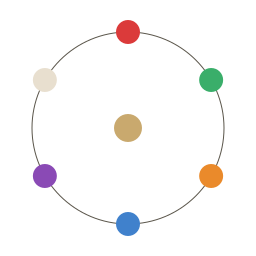
How does ibogaine kill — and how do we prevent it?
Cardiac is where most of the deaths are: ibogaine and its long-lived metabolite noribogaine block the hERG potassium channel, prolong the QT interval, and can trigger fatal arrhythmia. But it is not the only way ibogaine harms — drug interactions, co-ingestants, hepatic strain and unsupervised street-sourced dosing all recur in the fatality record. Almost every one of those deaths carried a risk factor an ECG, an electrolyte panel or a CYP2D6 test would have caught first.
How do we use ibogaine to help people — safely?
The discipline that turns a dangerous molecule into a managed procedure: pre-screening — ECG, electrolytes, CYP2D6 phenotype — dose strategy, and continuous cardiac monitoring through the window of risk. This is where the field’s hard-won practice is written down: the difference between an unsupervised gamble and a protocol a clinician can stand behind.
How does ibogaine do what it does, in the brain and body?
Ibogaine is pharmacologically promiscuous — acting across opioid, NMDA, serotonergic, sigma and nicotinic systems at once — and is converted by the liver enzyme CYP2D6 into noribogaine, whose long half-life shapes both the therapeutic effect and the cardiac danger. The receptor pharmacology and pharmacokinetics every other category ultimately rests on.
What does ibogaine change — and does it last?
The trials, observational cohorts and follow-up studies measuring ibogaine’s effect on opioid and other substance-use disorders — the size of the signal, how durable it proves, and an honest account of where the evidence is thin, uncontrolled, or absent. Efficacy claimed is not efficacy shown; this category keeps the two apart.
What is ibogaine like, from the inside?
The experience itself, treated as data rather than decoration: the oneirogenic waking-dream state, the panoramic life-review, the altered phenomenology patients describe with striking consistency — and the emerging instruments built to measure it. Held at equal weight to the clinical categories, never demoted as merely subjective.
Where did ibogaine come from — and how has it moved through the world?
From the Bwiti tradition of Gabon, to Howard Lotsof’s 1962 discovery that iboga could interrupt opioid withdrawal, to the prohibition, activism and present-day clinical renaissance that followed. Deep history and modern history together — the context that explains why the science sits where it does, and why it was so long ignored.